
Colour Inkjet Coding: Transform Your Packaging with Digital Print
Paper labels falling off during transport. Label suppliers unable to meet your deadline. Three months’ worth of pre-printed packaging sitting in your warehouse because your product line changed. If any of these scenarios sound familiar, it’s time to consider colour inkjet coding.
Digital label printing directly onto packaging eliminates the headaches of traditional labelling whilst accelerating your production line. Whether you’re running a food production facility in Dublin or a pharmaceutical operation in Cork, colour inkjet systems deliver the flexibility modern manufacturers need.
What Is Colour Inkjet Coding?
Colour inkjet coding prints full-colour graphics, text, barcodes and variable data directly onto your packaging materials in a single pass. Rather than applying pre-printed labels, these systems use digital inkjet technology to create vivid, high-resolution images on demand at production-line speeds.
The technology works inline or nearline with your existing packaging equipment, integrating seamlessly into food processing, beverage bottling, pharmaceutical packaging and consumer goods production lines across Ireland.
GSI NoLabel™ Inkjet Coding: Eliminate Labels Entirely
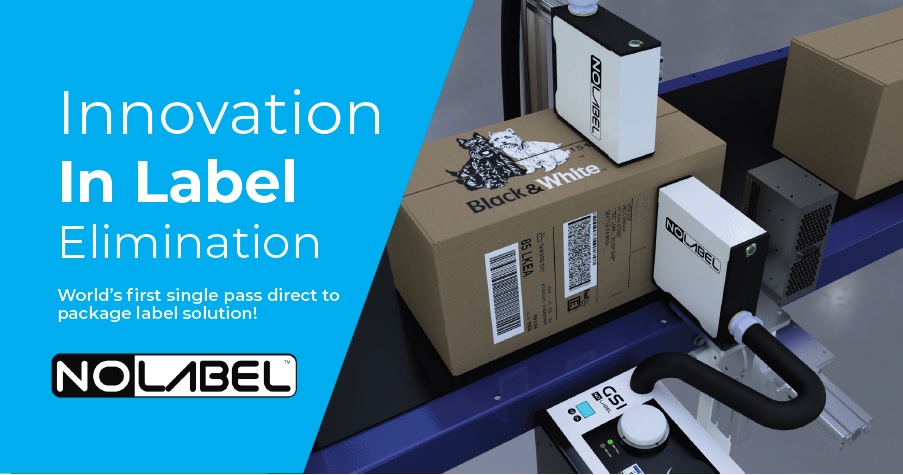
The GSI NoLabel™ system prints digital labels directly onto your packaging, removing paper labels and thermal transfer ribbons from your production process entirely.
NoLabel™ uses high-speed inkjet printheads to apply monochrome labels directly to packaging surfaces. The system prints at production speeds that exceed those of traditional print-and-apply equipment, creating crisp barcodes, product information, and compliance data without slowing your line.

Key Benefits of NoLabel™ Technology
Eliminates Label and Ribbon Costs
Paper labels and thermal ribbons represent recurring expenses that add up across high-volume production. NoLabel™ removes these consumable costs, with manufacturers typically seeing ROI within 18-24 months based on label volume.
Solves Label Adhesion Problems
Labels that peel, curl or fall off during transport create compliance issues and damage brand perception. Direct printing eliminates adhesion failures because the ink bonds directly to the packaging surface.
Reduces SKU Complexity
Pre-printed packaging forces you to maintain separate stock for each product variation. NoLabel™ allows one base package to serve multiple products, flavours, or markets; you simply change the digital file.
Increases Production Speed
Print-and-apply systems create bottlenecks, especially when labels jam or misalign. NoLabel™ prints at speeds exceeding traditional applicators, with fewer mechanical components to maintain or adjust.
Prevents Supply Chain Disruptions
Label shortages can halt production lines. With digital printing, you’re not dependent on external label suppliers meeting deadlines or minimum order quantities.
Delivers High-Contrast Barcodes
Scanning reliability matters for retail distribution and warehouse automation. NoLabel™ produces sharp, high-contrast barcodes that scan consistently, reducing rejected shipments and manual intervention.
This system works particularly well for high-volume carton printing in food and beverage operations, pharmaceutical packaging requiring variable batch information, and operations running multiple products through shared packaging lines.
GSI Colorize™ Inkjet Coding: Full-Colour Brand Impact
Colorize™ CMYK+W delivers full process colour printing directly onto your packages. This system combines cyan, magenta, yellow, black and white inks to create vivid graphics that enhance brand presence and enable targeted marketing strategies.
The Colorize™ system uses multiple inkjet printheads configured for CMYK+W printing. White ink provides a base layer on coloured or transparent packaging, ensuring colour accuracy regardless of substrate colour. Production speeds match your existing line rates, with inline or nearline configurations depending on your floor space and workflow requirements.


Key Benefits of Colorize™ Technology
Enables Dramatic SKU Reduction
Instead of stocking pre-printed boxes for every product variant, flavour and seasonal promotion, you maintain one base packaging design. The Colorize™ system adds product-specific graphics digitally, reducing warehouse requirements and obsolete packaging waste.
Creates Direct-to-Package Colour Graphics
Full-colour capability allows product photography, promotional graphics and brand elements to appear on packaging without labels or pre-printing. This opens opportunities for limited editions, regional variations and personalised packaging that were previously cost-prohibitive.
Reduces Warehouse Storage Requirements
Pre-printed packaging typically requires 60-90 days of inventory to justify print run economics. Digital printing eliminates this requirement, freeing valuable warehouse space and reducing capital tied up in packaging materials.
Supports Unlimited Label Variations
Recipe changes, regulatory updates and promotional campaigns no longer require new packaging inventory. Update the digital file, and your next production run reflects the changes immediately.
Enables Targeted Marketing and Personalisation
Regional preferences, retail channel requirements and promotional campaigns can each receive customised packaging without separate production runs. Connect to ERP systems via table data to automatically generate package variations based on order details.
Delivers Vivid, On-Demand Graphics
Colour quality matches offset printing standards, with the flexibility to change designs between production runs or even mid-run for different markets or customers.
Full-colour inkjet coding suits operations requiring brand-on-demand strategies for food and beverage companies, short-run product launches in consumer goods, retail-ready packaging across multiple channels, and custom packaging for contract manufacturing.
Technical Considerations for Colour Inkjet Systems
Substrate Compatibility
Both NoLabel™ and Colorize™ systems work across various packaging materials, including corrugated cardboard and folding cartons, coated and uncoated paperboard, flexible film (with appropriate surface treatment), and some plastics and rigid containers.
Porous substrates like cardboard typically require no preparation, whilst non-porous materials may benefit from corona treatment or primer coatings to ensure ink adhesion.
Integration and Maintenance
These systems integrate with existing production lines through conveyor-mounted inline configurations, standalone nearline printing stations, and connection to warehouse management and ERP systems. Installation typically requires coordination with production scheduling to minimise downtime.
Digital inkjet systems require routine maintenance, but substantially less intervention than mechanical label applicators. Printhead cleaning cycles are typically automated, with ink replenishment through cartridge-based systems. Planned maintenance typically involves monthly checks and annual service visits.
Cost Analysis: Digital Printing vs Traditional Labelling
Paper labels cost between €0.02 and €0.15 per label, depending on size, quantity, and printing complexity. Operations printing 100,000 units annually spend €2,000-€15,000 on labels alone, before factoring in thermal ribbons, adhesives and applicator maintenance.
Pre-printed packaging typically requires 60-90 days of inventory, representing significant capital tied up in materials. Digital printing reduces this to base packaging only, cutting inventory holding costs by 40-60%.
Recipe changes, regulatory updates and discontinued products create obsolete packaging waste. Digital systems eliminate this entirely-no pre-printed materials to scrap when formulations change.
High-volume operations (500,000+ units annually) see ROI within 12-18 months, whilst medium-volume producers (100,000-500,000 units) achieve payback in 18-30 months.
Industry Applications Across Ireland
Food manufacturers use colour inkjet for carton coding with batch information and expiry dates, promotional graphics for seasonal products, multi-language packaging for export markets, and retailer-specific packaging requirements.
Pharmaceutical operations benefit from serialisation and track-and-trace compliance, batch-specific regulatory information, and multi-market packaging from central production.
Consumer product manufacturers leverage colour inkjet for brand-on-demand strategies, reducing SKU complexity, retail channel-specific packaging, and promotional campaigns without inventory risk.
Choosing Between NoLabel™ and Colorize™
Choose monochrome NoLabel™ when your priorities include eliminating label and ribbon costs, improving barcode scan reliability, reducing SKU complexity, and faster changeover between products with lower initial capital investment.
Full-colour Colorize™ justifies the additional investment when you need brand presence and shelf impact through packaging, promotional flexibility and seasonal graphics, product photography or complex branding elements, and custom packaging for different retail channels.
Make Your Packaging Line More Flexible
Pre-printed labels and packaging create operational constraints that digital inkjet technology eliminates. Whether you’re dealing with label costs, supply chain disruptions, SKU proliferation or the need for promotional flexibility, colour inkjet coding addresses these challenges whilst maintaining or improving production speeds.
Obeeco supplies and supports GSI NoLabel™ and Colorize™ systems across Ireland, working with manufacturers to implement digital printing solutions suited to their specific production requirements. With over 45 years of supporting Irish manufacturers, we understand the operational realities of production environments and the importance of reliable equipment that integrates smoothly with existing lines.
Contact our team on (+353 1) 278 2323 or email sales@obeeco.ie to discuss how colour inkjet coding can transform your packaging operation. We’ll assess your current process, demonstrate the technology with your actual packaging materials, and provide a detailed implementation plan with projected cost savings and operational benefits.
Secure payment through bank transfer is available for all equipment purchases, ensuring straightforward transactions for your capital equipment investments.